

Epidemiology of Silence: Age Distribution and Lifestyle Determinants of Sleep Apnea in the USA
By SnailSleep Health Editorial Team
Abstract
Obstructive Sleep Apnea (OSA) affects an estimated 26% of adults aged 30-70 in the United States. However, aggregate data often obscures the nuanced relationship between specific age cohorts and their unique risk profiles. This paper analyzes the current age distribution of OSA patients and correlates these demographics with specific lifestyle habits, revealing a complex pathology that evolves from early adulthood into geriatrics.
The Bimodal Distribution of Diagnosis
While OSA prevalence generally increases with age, clinical observations suggest a "bimodal" peak in diagnosis intensity, driven by two distinct patient phenotypes.
1. The Early-Onset Phenotype (Ages 30-45)
This group is rapidly growing. The pathology here is often anatomical combined with high metabolic activity.
Primary Drivers: Visceral obesity, high stress (cortisol), and alcohol consumption.
Gender Disparity: Heavily skewed male (2:1), though the gap is narrowing.
2. The Late-Onset Phenotype (Ages 55+)
This group represents the traditional OSA patient.
Primary Drivers: Loss of muscle tone (sarcopenia) in the throat, redistribution of fluid while lying down, and menopause in women.
Gender Disparity: Nearly 1:1, as post-menopausal women lose the protective effect of progesterone on airway muscle tone.
Figure 1: Estimated OSA Prevalence by Age Group and Severity (USA)
| Age Group | Mild OSA (AHI 5-15) | Moderate/Severe OSA (AHI >15) | Primary Lifestyle Contributor |
|---|---|---|---|
| 18 - 29 | 9% | 3% | Screen time, Alcohol, Anatomy |
| 30 - 49 | 18% | 11% | Sedentary work, Weight gain |
| 50 - 69 | 29% | 19% | Menopause, Sarcopenia, BMI |
| 70+ | 35% | 24% | Neural control instability |
AHI = Apnea-Hypopnea Index (events per hour).
Lifestyle Habits: The Accelerants of Apnea
Beyond age and genetics, specific lifestyle habits act as accelerants, pushing predisposed individuals into clinical pathology.
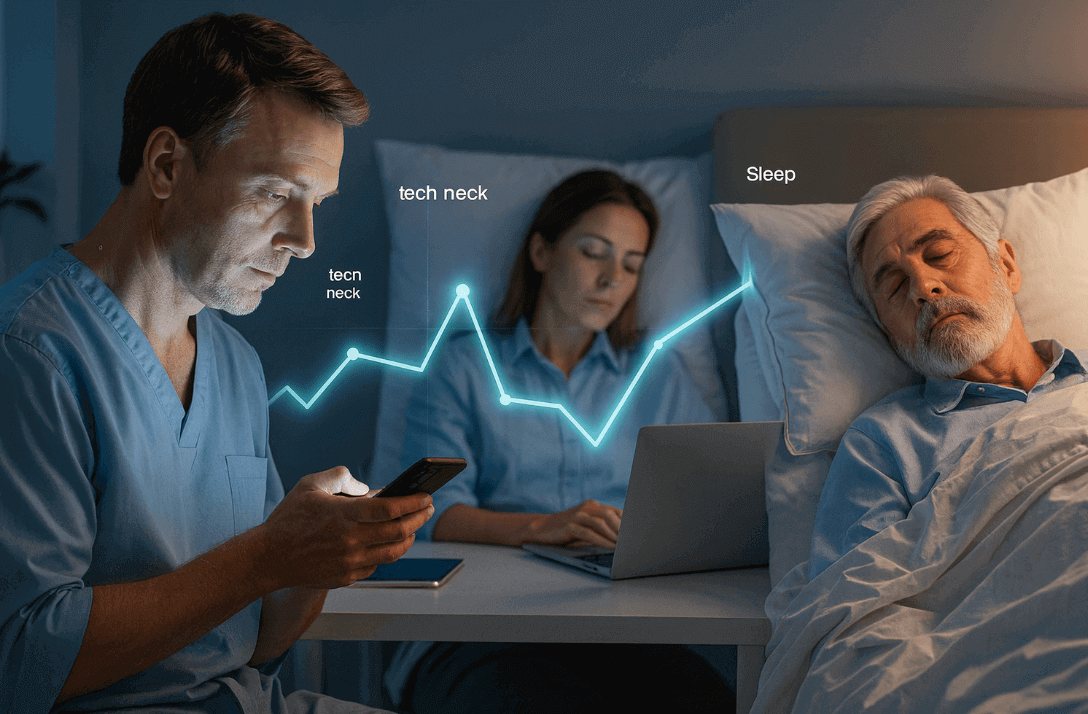
The "Tech Neck" and Postural Kyphosis
A novel contributor to the prevalence of OSA in younger demographics (30-45) is the alteration of cervical spine posture due to technology usage.
Mechanism: Chronic forward head posture ("text neck") alters the hyoid bone position and shortens the suprahyoid muscles.
Result: This structural change reduces the retro-glossal airway space. Even when the patient lies supine to sleep, the cervical spine retains a degree of kyphosis that compromises airway patency.
The Sedentary-Circadian Disruption Loop
The American workforce has transitioned to predominantly sedentary roles. This impacts OSA via fluid mechanics rather than just fat accumulation.
Rostral Fluid Shift: In sedentary individuals, fluid accumulates in the legs during the day. Upon lying down, this fluid shifts rostrally (towards the head), causing edema in the neck tissues within minutes of sleep onset.
Data Point: Studies indicate that active walking reduces the severity of OSA independently of weight loss, likely by reducing leg fluid retention.
Dietary Composition and Inflammation
The Standard American Diet (SAD), high in processed carbohydrates and omega-6 fatty acids, creates a state of systemic inflammation.
Cytokines: Elevated inflammatory markers (CRP, IL-6) are consistently found in OSA patients.
The Vicious Cycle: Inflammation causes airway swelling -> Apnea causes hypoxia -> Hypoxia causes more inflammation. This cycle is particularly aggressive in the 40-50 age bracket where metabolic syndrome often begins.
The "Weekend Warrior" Syndrome
Analysis of sleep tracking data reveals a pattern of "social jetlag" that exacerbates apnea events.
Pattern: Irregular sleep schedules (staying up late weekends, sleeping in) desynchronize the circadian clock.
Impact: This desynchronization reduces the neuromuscular compensation that usually keeps the airway open. A patient might have an AHI of 10 (mild) on a Tuesday but an AHI of 25 (severe) on a Saturday night following alcohol intake and a shifted sleep time.
Clinical Implications
Understanding the age distribution allows for targeted therapy.
For the 30-45 Demographic: Therapy should focus on weight management, positional therapy (avoiding back sleeping), and orthodontic expansion.
For the 55+ Demographic: Therapy must prioritize CPAP or hypoglossal nerve stimulation, as tissue laxity is less reversible via lifestyle changes.
Summary
The epidemiology of Sleep Apnea in the US is a mirror of our lifestyle evolution. It is no longer solely a disease of the obese elderly; it is a condition manufactured by our posture, our diet, and our stress levels. As the population ages, the burden of OSA will increase, but the rising tide of early-onset cases suggests we must look at prevention in our 20s and 30s to stem the tide.
Frequently Asked Questions
What age group is most affected by sleep apnea in the US?
While OSA prevalence increases with age (35% mild OSA in those 70+), there's a significant "bimodal" pattern. The 30-45 age group represents a rapidly growing early-onset phenotype, while the 55+ group represents traditional late-onset OSA. The 50-69 bracket has the highest combined moderate-to-severe rates at 19%.
Why are younger adults (30-45) developing sleep apnea?
The early-onset phenotype is driven by visceral obesity, high cortisol from chronic stress, alcohol consumption, and anatomical factors. Additionally, "tech neck" from device usage alters cervical spine posture and reduces airway space. This group is predominantly male (2:1 ratio), though the gap is narrowing.
How does "tech neck" contribute to sleep apnea?
Chronic forward head posture from technology use alters the hyoid bone position and shortens suprahyoid muscles. This structural change reduces the retro-glossal airway space. Even when lying down to sleep, the cervical spine retains kyphosis that compromises airway patency, contributing to OSA in the 30-45 demographic.
Why do sedentary jobs increase sleep apnea risk?
Beyond weight gain, sedentary work causes "rostral fluid shift." Fluid accumulates in the legs during sitting, then shifts toward the head when lying down, causing neck tissue edema within minutes of sleep onset. Studies show active walking reduces OSA severity independently of weight loss by reducing leg fluid retention.
How does weekend sleep schedule affect sleep apnea severity?
"Social jetlag"—staying up late and sleeping in on weekends—desynchronizes the circadian clock. This reduces the neuromuscular compensation that keeps airways open. A patient might have mild AHI (10) on Tuesday but severe AHI (25) on Saturday after alcohol and shifted sleep timing.
How should treatment differ by age group?
For ages 30-45: Focus on weight management, positional therapy (avoiding back sleeping), and orthodontic expansion, as causes are often lifestyle-related and reversible. For ages 55+: Prioritize CPAP or hypoglossal nerve stimulation, since tissue laxity from sarcopenia is less reversible through lifestyle changes alone.
Key Takeaways
- OSA affects 26% of US adults aged 30-70, with a "bimodal" peak in the 30-45 and 55+ age groups
- Early-onset OSA (ages 30-45) is driven by obesity, stress, alcohol, and "tech neck" posture—and is rapidly growing
- Sedentary work causes "rostral fluid shift" that swells neck tissues at sleep onset, worsening apnea independently of weight
- The Standard American Diet creates inflammation that feeds a vicious cycle: swelling → apnea → hypoxia → more inflammation
- Social jetlag can double AHI severity; consistent sleep schedules are critical for airway neuromuscular function
References
- Wisconsin Sleep Cohort Study: Longitudinal analysis.
- American Academy of Sleep Medicine (AASM) Epidemiology Reports.
- Journal of Clinical Sleep Medicine: "Fluid shifts and sleep apnea severity."
Published by SnailSleep Health Editorial Team
Published on December 4, 2025
Related Articles
- Sleep Apnea Treatment Options: From CPAP to Lifestyle Changes
- Sleep Apnea Solutions: Natural Treatment & Lifestyle Changes
- Sleep Apnea and Weight Management: A Critical Link to Better Sleep and Health